
Students are asking for clarity in the use of gen AI in learning activities and assessments, adapted to the specific learning objectives of the diverse fields and learning objectives (Bearman et al., 2025; Carbonel & Jullien, 2025; DEC, 2025). When expectations are unclear, students end up using AI tools without guidance or shared norms, often covertly. This leads to confusion, the impossibility to enforce academic integrity and perceived unfairness. 

Thus, for each course, and often each learning activity or assessment, teachers need to clearly state:

  • Which uses are allowed or not (or even encouraged)
  • Which uses must be declared
  • The reason for such choices 

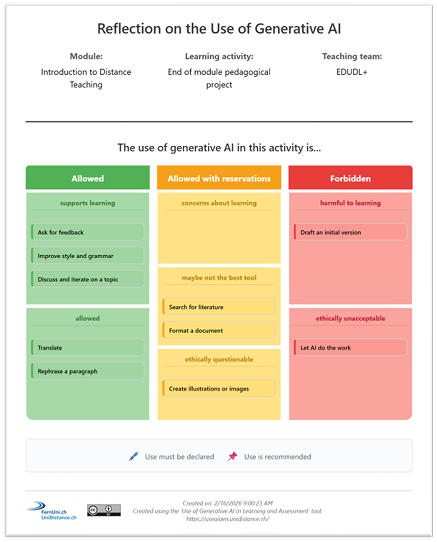
The tool UseGenAI offers a structured way to reflect on and communicate how generative AI (gen AI) may or may not be used in a specific learning activity or assessment. It includes justification of the choices linked to whether the use of gen AI supports or not learning or is ethically questionable. Its goal is to help clarify expectations and support open, responsible discussion between teachers and students.

For each type of use, you can decide whether gen AI should be:

  • Allowed — two subsections indicate whether its use supports learning or is simply permitted.
  • Allowed with reservations — three sections indicate when it may raise concerns about learning, may not be the most suitable tool, or may be ethically questionable.
  • Forbidden — two sections indicate when such a use may harm learning or be ethically unacceptable.

The tool includes common examples of gen-AI uses (e.g., writing a literature review, drafting an initial version, improving style and grammar), which you can adapt or extend as needed.


How to use UseGenAI

  1. Choose a specific learning activity or assessment. The use of gen AI depends on the intended learning outcomes for the given activity.
  2. Drag and drop the relevant uses of gen AI into the appropriate box. This can be done individually or collaboratively with students or colleagues. You don’t need to use every suggestion and can add your own if needed.
  3. Add the icons:
    • ✏️ pen = students must cite this use of gen AI
    • 📌 pin = the use of gen AI is recommended
  4. Export the table as a PDF. Note: your work is not saved automatically when you leave the application. Make sure to download your table before closing the page.
  5. Share and discuss the results with your students if they did not take part in the activity design.

Access UseGenAI


Example


References

Bearman, M., Fawns, T., Corbin, T., Henderson, M., Liang, Y., Oberg, G., Walton, J., & Matthews, K. E. (2025). Time, emotions and moral judgements: How university students position GenAI within their study. Higher Education Research & Development, 0(0), 1–15. doi.org/10.1080/07294360.2025.2580616

Carbonel, H., & Jullien, J.-M. (2025). Enseignement superieur et IA generative un systeme sous tension. In A. Baillifard & H. Carbonel, L’éducation à l’épreuve de l’intelligence artificielle. Epistémé.

DEC. (2025). Student Voices on AI: An Actionable Guide for Institutions and FacultyDEC Insights.