UniDistance Suisse’s quality assurance system ensures that teaching, research and services are continuously developed and improved. The aim is to promote a sustainable culture of quality and to meet the institutional requirements for higher education institutions. 

The Quality Assurance Support Unit is responsible for managing the quality assurance system in accordance with the quality assurance strategy and advises the Rectorate and other university units on the planning and implementation of improvement measures as well as institutional accreditation. You can find out more about the tasks and activities of the Quality Assurance Support Unit here. 

Meet the team

Furthermore, the Quality Assurance Support Unit is responsible for matters relating to sustainable development 

The LGQM is a standing committee of UniDistance Suisse that deals with ensuring and further developing the quality of study programmes, teaching and institutional processes. As a strategic body, it develops and reviews the quality assurance strategy as well as the associated objectives and measures.  

The LGQM consists of a representative of the Foundation Board Committee (Chair of the Steering Group), the Director of Academic Services, the Director of Central Services, a representative of the professors, the Head of EDUDL+ and the Head of the Quality Assurance Support Unit. 

Tasks and activities of Quality Assurance

Management of the quality assurance system

Quality Assurance coordinates and further develops the institutional quality assurance system at UniDistance Suisse. This is based on a continuous improvement process following the PDCA cycle (Plan – Do – Check – Act), which enables the systematic planning, implementation, review and further development of quality measures. 

Support for institutional accreditation

A central component of the work is supporting the institutional accreditation process in accordance with the Higher Education Promotion and Coordination Act (HFKG). Quality assurance coordinates, amongst other things, the preparation of the self-assessment, the documentation of quality processes and collaboration with internal and external stakeholders. FernUni Schweiz received a positive accreditation decision in 2020; the next re-accreditation is scheduled for 2027. 

Learn more

Evaluation of study programmes and teaching

The Quality Assurance department organises and oversees various evaluation formats to systematically review the quality of study programmes. These include course evaluations, programme evaluations and student satisfaction surveys. The results serve as a basis for improvement measures. 

  • Teaching evaluation

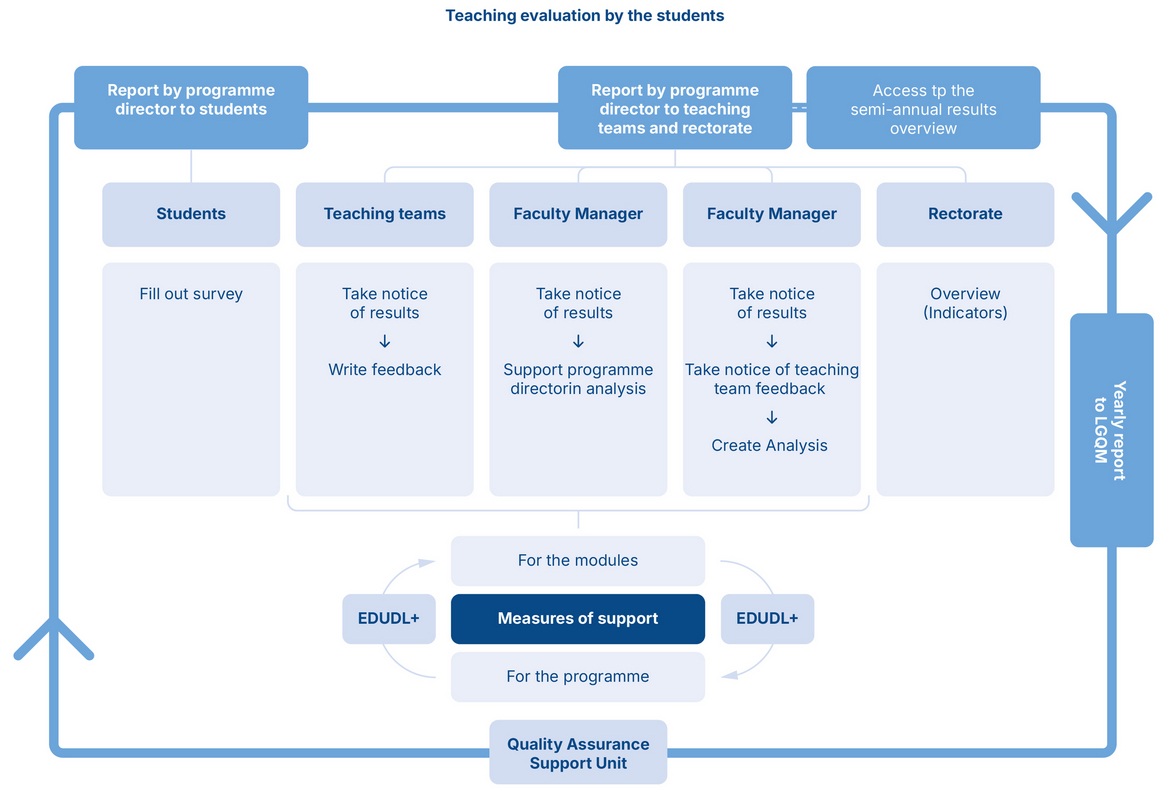
    As part of the student evaluation of teaching, all modules are assessed each semester against various criteria such as module design, resources and learning activities, interactions, assessment methods and feedback, as well as workload. The programme directors analyse the results and provide feedback to students and teaching teams. 

  • Programme Evaluation

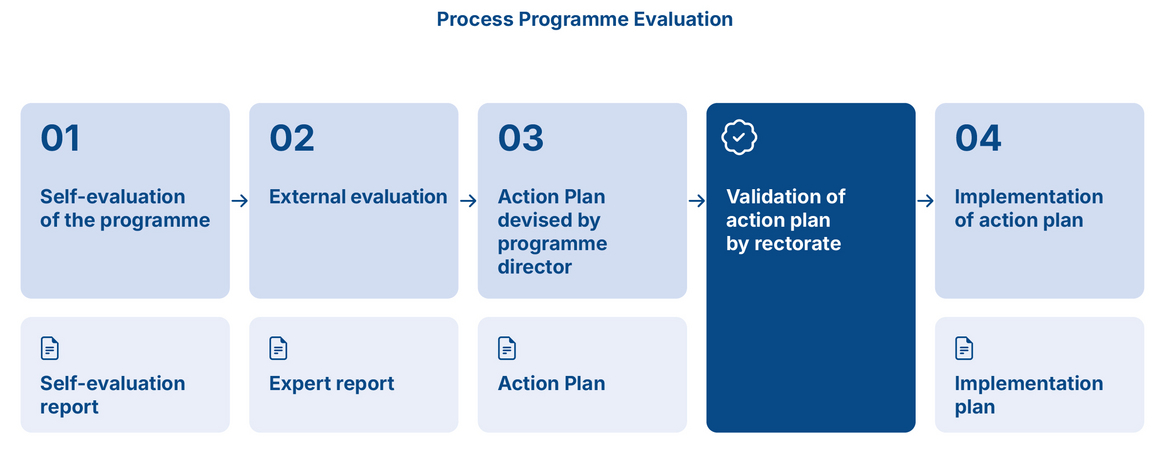
    Our degree programmes are regularly evaluated in accordance with HFKG standards for programme accreditation through a self-assessment process involving external experts. The outcome of this process is an action plan, the implementation of which is supported by the Rectorate and the Quality Assurance Support Unit.

  • Satisfaction Barometer

    The satisfaction barometer is conducted every two years among students at UniDistance Suisse. The aim is to gain a clearer understanding of students’ needs, expectations and concerns regarding UniDistance Suisse as a university institution and distance learning. The results provide an overview of various aspects of the course and the study environment. Where necessary, in-depth analyses can be carried out on this basis to identify targeted improvement measures. 

    View the Satisfaction Barometer (in French)

    View the Satisfaction Barometer (in German)

Process Management and Quality Development

Another key focus is the establishment and further development of process-based quality management. Quality assurance supports organisational units in documenting and optimising processes, developing a QM manual, and implementing quality standards in administrative and academic processes. 

Advice and Support for the Rectorate

Quality Assurance advises the Rectorate and other university units on the planning and implementation of improvement measures. This includes, in particular, the analysis of evaluation results and the development of strategic quality objectives. 

  • Quality Assurance Strategy

    UniDistance Suisse’s quality assurance strategy aims to ensure and continuously improve excellence across all areas of activity, in order to deliver outstanding performance and thereby facilitate cutting-edge academic research, excellent teaching, international visibility, innovation, societal impact and structural quality. It promotes a culture of quality in practice, which identifies necessary changes through regular reflection and the participation of all stakeholders and supports their implementation.

    View the Quality Assurance Strategy (in French)

    View the Quality Assurance Strategy (in German)

  • Graduate Survey

    The Graduate Survey is conducted every two years and is aimed at graduates of UniDistance Suisse. It offers them the opportunity to share their experiences of their studies as well as their assessment of the skills acquired during their studies. 

    The results provide valuable feedback on the quality of the study programmes and highlight the extent to which the skills taught meet the requirements of professional life. This enables study programmes to be continuously developed and improved. 

  • Staff survey

    The Staff Barometer is conducted regularly among the staff of UniDistance Suisse. The survey offers staff the opportunity to assess various aspects of their working situation and working environment. 

    At the same time, the Rectorate gains valuable insights into staff perceptions, needs and expectations. The results serve as a basis for developing targeted measures to further improve working conditions and strengthen the organisation. 

Development of a quality culture

In addition to structural processes, quality assurance promotes a university-wide quality culture. The aim is to establish quality as a shared responsibility of all stakeholders and to support the exchange of best practice. A common understanding of quality 

Quality in digital learning

UniDistance Suisse participates in the European quality network E-xcellence (EADTU). This benchmarking tool supports the further development of quality in digital teaching and learning formats, particularly in the areas of strategic management, curriculum design, course delivery and support for students and lecturers. 

  • EFQM

    FernUni Schweiz uses the EFQM model (European Foundation for Quality Management) as a holistic management framework for the further development of quality, excellence and sustainable organisational development. As part of an external evaluation, the institution was assessed against the criteria of the EFQM model and the PDCA cycle (Plan–Do–Check–Act). 

    This assessment was awarded the ‘Qualified by EFQM’ label in 2022. The process supported UniDistance Suisse in systematically advancing its organisational development in line with the objectives of Strategy 2027. 

  • E-xcellence

    The E-xcellence model of the European Association of Distance Teaching Universities (EADTU) is a quality benchmarking tool specifically designed for distance learning and e-learning. It supports higher education institutions in analysing and further developing the quality of their study programmes at programme, faculty and institutional levels. 

    As part of the self-assessment, institutions focus on four key dimensions of modern higher education: accessibility, flexibility, interactivity and personalisation. UniDistance Suisse uses the E-xcellence model as a guide for innovation in the field of digital and flexible distance learning and as preparation for future external evaluations. 

Risk Management: ICS & BRA

UniDistance Suisse uses two key tools to systematically identify and manage risks: the Internal Control System (ICS) and the Business Risk Assessment (BRA). 

The ICS comprises internal controls, processes and security measures that ensure correct, lawful and efficient operations within the institution. In particular, it serves to review administrative processes and financial risks. The principles of the ICS were revised by the Board of Trustees in 2023. The Governance, Quality Management and Monitoring Department (LGQM) is responsible for the implementation and annual review of the control measures. 

The BRA complements the ICS by analysing not only internal risks but also strategic and business-related risks at UniDistance Suisse. Its implementation is coordinated by the Quality Assurance Support Unit. A working group comprising representatives from the Foundation, the faculties and the administrative services identifies the most significant institutional risks and defines appropriate measures.