

Switzerland is often portrayed as a small, neutral country standing apart from the major political and imperial conflicts of the past. Yet in the early twentieth century, Switzerland was deeply connected to the transformations reshaping Europe and the wider world.
It ultimately asks what it means to understand Switzerland not from the margins of global history, but as an active node within the networks that shaped the modern world.
The first strand examines Switzerland’s connections to two major railway projects: the Orient Express and the Berlin–Baghdad Railway. Railways were not simply infrastructures for moving people and goods; they were also instruments of economic expansion, diplomacy, and imperial competition. Swiss engineers, financiers, and technical experts contributed to these international projects. One example is Jakob Müller of Lucerne, who became director of the Orient Express around the turn of the century. After the First World War, the Simplon Orient Express established a new route through Switzerland and the Alps, further demonstrating the country’s position within Europe’s changing transport networks. This strand traces Swiss involvement in these projects through expertise and finance, from the late 19th century into the postwar period.
The second strand examines Switzerland during the First World War, when around 67,000 wounded or sick prisoners of war (PoW) from both the Allied and Central Powers were interned in the country. From 1916 onward, selected PoWs from Germany, France, Belgium, and Britain were admitted for medical treatment. Their selection was based on pre-agreed medical criteria and assessed not only by doctors representing the belligerent powers, but also, and crucially, by Swiss medical commissions. This system brought humanitarianism, medicine, and diplomacy together, revealing the forms of governance through which Swiss neutrality operated during wartime. Focusing on selected PoW camps in the cantons of Vaud, Bern and Valais, such as Château-d’OEx, Leysin, Murren, Crans-Montana, Brig, Visp, and Zermatt, this strand investigates questions of surveillance, governmentality and social order.

Orient Express near Constantinople, circa 1900. Source: Wikimedia, bit.ly/4j7QQAB
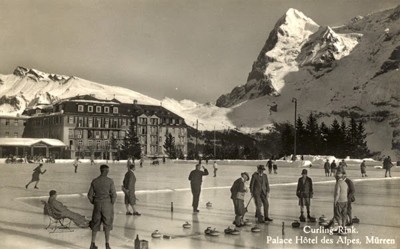
British PoWs curling at Mürren, in the canton of Bern. Source: bit.ly/3SRhWBz