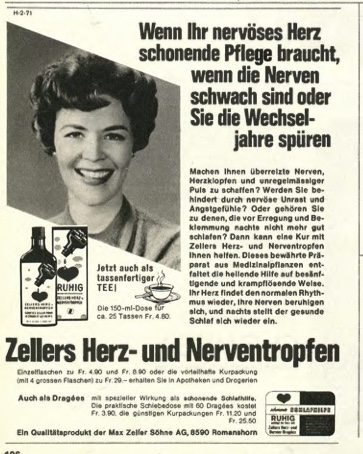
Research on menopause was long dominated by medical perspectives framing it as a disease rather than a situated process. In the 19th century, male French doctors framed menopause as a pathological state requiring medical treatment. At the beginning of the 20th century, the discovery of hormones and the development of Hormone Replacement Therapy (HRT), associated menopause with hormonal deficiency necessitating medical intervention. Research has thus often portrayed menopausal individuals as passive medical ‘patients’, narrating women’s ageing as inevitable decline, with individual and socio-cultural perspectives overlooked. This project shifts that perspective. It analyses menopause as historically changeable (see Melby et al., 2005) and connected to intersectional hierarchies, researching the histories of menopause since 1960.
Shifting narratives of menopause intersect with hierarchies of sex/gender, race/ethnicity, age and class. Early modern Europe depicted menopausal women as sexually promiscuous ‘witches’ (Botelho, 2015). 19th century doctors claimed that upper-class European patients suffered more, defining menopause as an experience of the ‘civilized’, while poor, peasant, and non-white people were deemed ‘primitive’. By the 20th century, “menopause was constructed as white, middle- or upper-middle-class, and suburban” in the USA (Mattern, 2019, p. 288). In the 1960s, Feminine Forever linked the use of hormones for menopause treatment to preserve ageing women’s youth and attractiveness (Houck, 2003). Capitalist interest grew, turning HRT into a billion-dollar industry. While HRT may help many, it also perpetuated the idea that something is wrong or missing in the ageing female body (Lewis, 1993; Wolf, 2009). Although the history of menopause received significant scholarly attention in the USA and GB, and a limited number of German research studied both women’s and men’s menopause, significant gaps remain, both geographically, and theoretically. Historical research that bridges discourse and the body and that goes beyond binary understandings of who may experience menopause remains particularly scarce.
This project asks, what we can learn about the histories of the body, ageing, sex/gender, health and medicine since the 1960 through the lens of menopause. How have discourses and experiences of menopause changed over time? How have individuals’ experiences of menopause changed and how was menopause constructed and narrated in relation to sex/gender, health and medicine? How have ideas about sex/gender, ageing, and the body been negotiated and normalised?
Theoretically it applies a critical sex/gender and body historical approach, inspired by material-discursive perspectives. The project also applies an explorative double focus on Switzerland and Sweden, providing different contexts of societal hierarchies as well as health care systems. The project analyses textual and audiovisual sources from various archives, ranging from traditional sources to oral history interviews to social media.