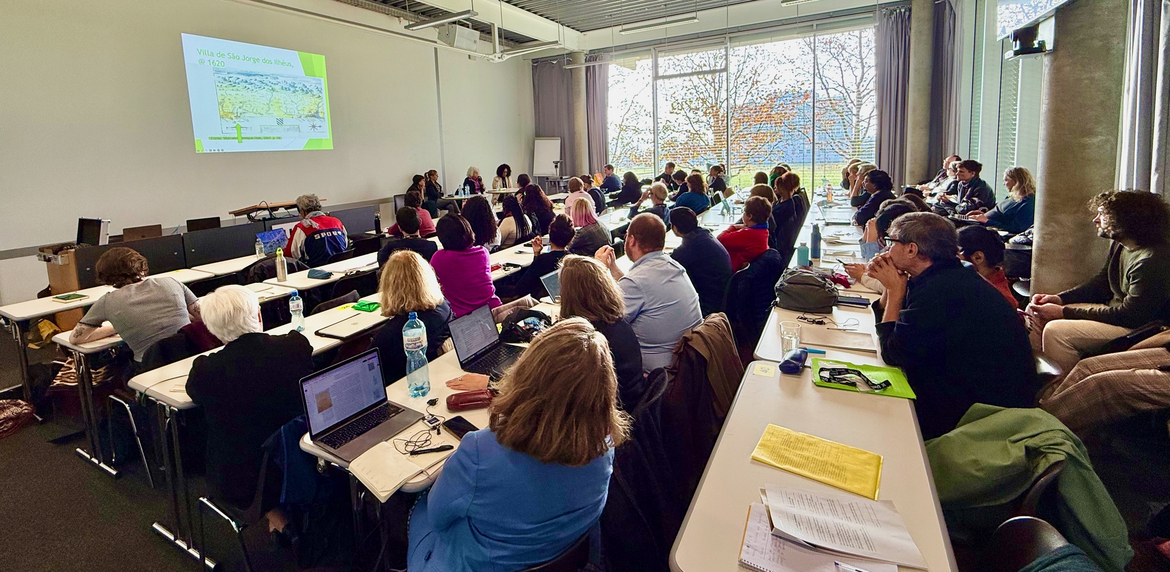
The conference Slavery, Resistance and Democracy, held on November 5–7, 2025, at the University of Lausanne, sought to historicize the apparent contradiction between slavery and democracy in the 19th century and to explore its ongoing legacies by examining the economic, political, and cultural networks linking Brazil and Switzerland. It brought together scholars from Brazil, Europe, and the United States who study the history of exchanges in the southern transatlantic world.

The conference opened on November 5 with a Salon Historique featuring Maria Helena P. T. Machado and Rafael de Bivar Marquese of the University of São Paulo, Mary Ann Mahony of Central Connecticut State University, and Béatrice Ziegler of FHNW and the University of Zurich, moderated by conference organizers Izabel Barros and Bernhard C. Schär. The program included well-attended panels on gender, industry, Indigenous agency, trade and finance, the Swiss-German colony Leopoldina, scientific networks, and the legacies of slavery in the 20th century.

The inspiring encounters and discussions during the event laid the groundwork for further developing academic exchange and research on the extensive transatlantic connections that have profoundly shaped both Switzerland and Brazil. All panels, the opening and closing sessions, and the keynote were recorded. The videos are available below, along with interviews conducted by Michal Roost (UniDistance Suisse) with selected conference speakers.

Consult the programme

The conference was part of the SNSF Eccellenza research project Moral and Economic Entrepreneurship: A Collaborative History of Global Switzerland, based at the University of Lausanne’s Institute of Political Science. It was organized by the project leader, Bernhard C. Schär, and the PhD researcher Izabel Barros. This event was made possible thanks to the support of the following institutions:

Conference playlist

Participants:

  • Béatrice Ziegler, Professor emeritus, FHNW & University of Zurich
  • Rafael de Bivar Marquese, University of São Paulo
  • Mary Ann Mahony, Central Connecticut State University
  • Maria Helena Machado, University of São Paulo
  • Moderators: Bernhard C. Schär and Izabel Barros

Participants:

  • Izabel Barros, University of Lausanne: Beyond the Ledger: Enslaved Women's Lives on a Swiss-Owned Plantation in Nineteenth-Century Ilhéus, Bahia
  • Ayalla Oliveira Silva, Universidade Federal de Pernambuco: The Camacã indigenous nation and the plantation owner Fernando Steiger: agricultural frontier, labor relations, and indigenous resistance in Ilhéus, Brazil, in the 19th Century
  • Mary Ann Mahony, Central Connecticut State University: Incorporating Newcomers: Slave owning and the Extended Sá Family
  • Chair: Rahel Kunz

Participants:

  • Hans Fässler, Independent researcher: «The Curse of Dishonoured Humanity» MP Wilhelm Joos and the Swiss Parliamentary Debate of 1863/1864 on Swiss Slaveholders in Brazil
  • André Nicacio, Independent researcher: Powered by steam, driven by slave labor: the Porchat factories and São Paulo's first industrialization (1839-1888)
  • Fabio Rossinelli, University of Lausanne: The role of the state behind Swiss expansion in Brazil in the long 19th century
  • Chair: Pierre Eichenberger

Participants:

  • Monique Ligtenberg, ETH Zurich: Commodifying the Amazon: A German Painter, a Swiss Industrialist, and the Transimperial Butterfly Trade (1890–1920)
  • Nelson Sanjad, Goeldi Museum: Tropics as a Career Choice: German-speaking Swiss Scientists in the Amazon (1890-1920)
  • Chair: Stéphanie Ginalski

Participants:

  • Andreas Zangger, Independent researcher: Swiss Threads in Brazil’s Slave Economy, 1830–1852
  • Ricardo Bormann, Universities of Neuchâtel: The International Neuchâteloise: Family Businesses, Fortunes, and Colonialism
  • Alain Naef, ESSEC Paris: Banking on Empire: David de Purry, London Financiers, and the Portuguese Atlantic
  • Chair: Sandra Bott

Speaker: Maria Helena Pereira Toledo Machado, University of Sao Paulo

Participants:

  • Aretuza da Cruz Silva, Federal University of Espírito Santo: The ecclesiastical records of baptisms of free and enslaved people in Villa Viçosa and Colônia Leopoldina (1829-1847)
  • Yuko Miki, Fordham University: On the Frontiers and Margins: Race, Nation, and Colonization in Southern Bahia and Brazilian Amazonia
  • Denise Bertschi, Collegium Helveticum Zurich: Agence Consulaire Suisse Léopoldine’ – The stamp of the Swiss federal government on the land of Colônia Leopoldina in Southern Bahia
  • Chair: Thomas David

Participants:

  • Michael Schmitz, University of Lausanne / UniDistance Suisse: Between continuities and change: Cacao trade and production in the South of Bahia on the example of the Swiss-Brazilian company Wildberger & Cia., first half of the 20th century
  • Kátia Vinhatico Pontes, State University of Santa Cruz: Cocoa and labour in the post-abolition South of Bahia (20th century)
  • Béatrice Ziegler, Prof. em. PH FHNW: Brasilian import substitution industrialisation and Swiss emigration control: Silk ribbon weavers from Basel for silk spinning mills in Brazil, 1912-13
  • Chair: Álvaro Tomás Gonçalves Sousa

Participants:

  • Gilsineth Santos, Helécia Quilombo community: Helvécia: Memory of a Living Tradition and its Pretagogia (Black Pedagogy)
  • Larissa Tiki Imbassi, University of Fribourg: Walking Through Colonial Archives: Brazil in the Public Memory of Neuchâtel
  • Chair: Aline Martello

Reflections by:

  • Izabel Barros
  • Maria Helena Pereira Toledo Machado
  • Rafael de Bivar Marquese
  • Ayalla Oliveira Silva
  • Moderator: Bernhard C. Schär

Interview with conference speakers by Michal Roost (UniDistance Suisse)

Michal Roost, a Master’s student in History, was responsible for the preparation, the selection of speakers, the recording and the editing of a series of video interviews produced during the conference. This work included technical and scholarly preparation, presence throughout the three days of the conference, the recording of interviews, and post-production (reviewing, editing and subtitling). The project provided the student with an opportunity to apply and refine methodological and science-communication skills (selecting and contextualizing research questions; translating academic arguments into accessible audiovisual formats), and to reflect on the ethical and representational issues involved in the visual presentation of sensitive sources.

Consult the video collection on SwitchTube